
Thoughts on Generative Artificial Intelligence
For this blog post, I decided to experiment with a basic generative artificial intelligence platform to illuminate the difference between my thinking and the predictive text produced by machine. If you are pressed for time, here's the finding: In my experiment, generative AI produced an answer while my free write produced a problem.
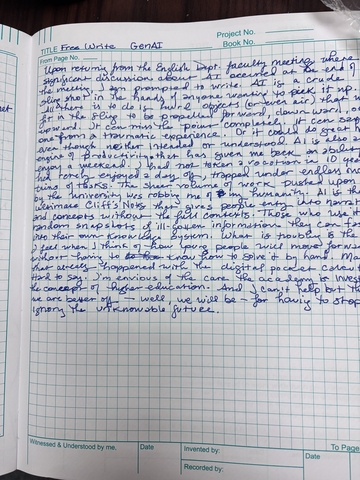
The image above shows my original free write. I wrote by hand because that sets the stage for my most free-wheeling writing. Because I am a lefty who writes with a fountain pen, here is the transcript, which I asked generative AI to produce.
Generative Artificial Intelligence and Higher Education
Transcript of my handwritten text
Upon returning from the English Dept. faculty meeting where significant discussion about AI occurred at the end of the meeting, I am prompted to write. AI is a crude slingshot in the hands of anyone wanting to pick it up. All there is to do is hurl objects (or even air) that will fit in the sling to be propelled forward, downward, or upward. It can miss the point completely. It can save one from a traumatic experience. Or it could do great harm even, neither intended nor understood.
AI is also an engine of productivity that has given me back an ability to enjoy a weekend. I had not taken a vacation in 10 years, had rarely enjoyed a day off, trapped under endless mountains of tasks. The sheer volume of work pushed upon me by the university was robbing me of my humanity.
AI is the ultimate Cliff’s Notes that gives people entry into humanity and concepts without the full contexts. Those who use it have random snap shops of ill-gotten information they can fashion into their own knowledge system.
What is troubling is the fear when I think of how young people will move forward without having to do the know how to solve it by hand. Maybe that already happened with the digital pocket calculator.
Hard to say. I’m envious of the care the academy is investing in the concept of higher education. And I can’t help but think we are better off — well, we will be — for having to stop ignoring the unknowable future.
Next, I gave generative AI a prompt to write about AI in higher education. Here is the output.
Generative AI in Higher Education
Generative artificial intelligence is changing higher education by providing students, faculty, and staff with new tools for completing academic and administrative tasks. These technologies can generate text, summarize information, answer questions, create images, analyze data, and assist with research. As their capabilities improve, colleges and universities must determine how they can be used effectively while maintaining academic standards.
For students, generative AI can provide individualized assistance with brainstorming, writing, studying, and understanding difficult concepts. It may be particularly useful when students need additional explanations or opportunities to practice. However, reliance on AI may also prevent students from developing important skills independently. Faculty therefore need to consider which learning activities should permit AI use and which should require students to demonstrate their own knowledge and abilities.
Faculty can also use generative AI to support teaching. AI can help develop assignments, generate examples, revise instructional materials, create discussion questions, and provide preliminary feedback. These applications may reduce the amount of time required for routine tasks and allow faculty to devote more attention to students.
Higher education institutions must also address concerns about accuracy, privacy, bias, intellectual property, and academic integrity. Clear policies and AI literacy education will be necessary as these technologies become more common.
Generative AI will likely remain part of higher education. The challenge for institutions is not simply deciding whether to use it, but determining how to incorporate it in ways that support learning while preserving the intellectual work that education is intended to develop.
What Happened When I Asked AI to Write This
The most striking difference between the two pieces is that the AI text reports while my free write thinks. The AI version arrives knowing where it is going. Generative AI offers benefits and risks; faculty should use it thoughtfully; institutions need policies. Every paragraph does its job. It is competent, balanced, and remarkably well behaved.
My free write misbehaves.
It begins with a slingshot metaphor that I cannot quite control. It wanders into my own experience of work and the startling realization that AI has returned something to me that relentless productivity had taken away: weekends, days off, some measure of my humanity.
Then the argument turns against itself. The tool that has freed me from work I perhaps should not have been doing makes me worry that students will be freed from work they need to do. I wonder what happens when young people no longer know how to “solve it by hand.” Then I remember the pocket calculator and become suspicious of my own suspicion. SHELLOIL, anyone?
The AI version contains uncertainty, but it is tidy uncertainty: benefits, however, concerns, balance. Mine is genuine uncertainty. I do not know what I think yet. At one point I write, “we are better off — well, we will be,” correcting myself as the thought occurs.
That may be the difference that matters most. The AI produced an answer. I produced a problem:
Which kinds of difficulty help make us human, and which kinds merely consume our humanity?
Perhaps higher education needs both answers and problems.
But I know which one I would rather teach.